

Apache Tear Obsidian Guide to Grief, Resilience, and Respect

A small black pebble can hold more than one story at once. Apache Tear Obsidian is volcanic glass, a collector’s material, a popular crystal for grief work, and a name tied to painful stories about Indigenous loss. Learning about it well means holding all of that with care.
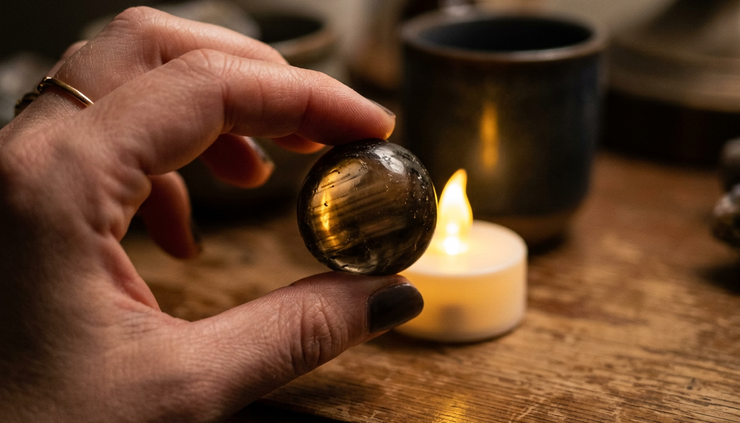
Apache Tears are often sold as rounded, dark nodules that look black in the hand. Hold one to a bright light and it may glow smoky brown, amber, or gray at the edges. That simple change is part of what makes the stone so moving for many people. It looks opaque until light passes through.
This guide separates three threads that often get tangled together: geology, cultural stories, and modern crystal beliefs. All three matter, but they are not the same thing.

Apache Tear Obsidian at a glance
Feature | What it means |
Material | Silica-rich volcanic glass, not a crystalline mineral |
Appearance | Small rounded dark nodules, usually black to smoky brown |
Transparency | Often looks black until held to strong light |
Formation | Obsidian nodules weathered out of volcanic rock, often perlite |
Modern associations | Remembrance, grief, grounding, emotional resilience |
Main care needs | Avoid impact, sharp chips, and abrasive cleaning |
Apache Tear Obsidian meaning is often described through grief, remembrance, and emotional steadiness. In crystal communities, people may use it as a symbolic object during mourning or reflection. In geology, though, it is not “grief made stone.” It is natural volcanic glass formed by heat, silica-rich lava, and rapid cooling.
Those two ways of seeing can sit beside each other as long as they remain clear. A stone can be meaningful without making medical claims. A name can carry a story without giving anyone permission to treat another culture’s grief as decoration.
Apache Tear Obsidian begins as volcanic glass
Obsidian forms when lava cools so quickly that atoms do not have time to arrange into crystals. Most obsidian comes from silica-rich lava, usually associated with rhyolitic volcanic activity. Silica makes lava thick and sticky. When that lava cools fast at or near the surface, it can harden into glass.
That is why obsidian is often described as volcanic glass rather than a mineral. Minerals have ordered crystal structures. Obsidian lacks that regular internal pattern, so geologists classify it as a mineraloid or natural glass.
Apache Tears are a specific form of obsidian. They are usually small rounded nodules found weathering out of volcanic deposits. Many come from perlite, a hydrated volcanic glass that can break down over time. As the surrounding rock erodes, the tougher obsidian nodules loosen and remain as rounded pieces.
Their shape can look water-worn, but it does not always mean they formed in a river. Weathering can free and smooth the nodules over long periods.
Why Apache Tears look black until backlit
A typical Apache Tear may look solid black in the palm. That is partly because the glass contains microscopic inclusions and iron-bearing material that absorb and scatter light. The nodule is also thick enough that little light passes through in normal conditions.
When you hold a small or thinner piece to a bright light, light can pass through the glass. The “black” stone may reveal smoky brown, cola, amber, or gray translucency.
This does not mean the stone changed. It means your eyes finally receive transmitted light instead of only reflected light. The same effect can happen with other dark glassy materials: they look opaque on a table, then glow at the edge when backlit.
How Apache Tears differ from snowflake obsidian and black onyx
Apache Tears, snowflake obsidian, and black onyx all appear in metaphysical shops, but they are not the same material.
Stone | What it is | How to recognize it |
Apache Tear Obsidian | Small nodules of dark volcanic glass | Rounded, black-looking pebbles that may glow brown when backlit |
Snowflake obsidian | Volcanic glass with pale mineral growths | Black glass with gray or white “snowflake” spots |
Black onyx | Chalcedony, a microcrystalline form of quartz | Smooth black stone, often banded or dyed in commercial jewelry |
Snowflake obsidian gets its spots from spherulites, rounded crystal growths that form as glass begins to devitrify, or slowly change from glass toward crystalline material. These pale spots are often made of cristobalite or related silica minerals.
Black onyx is different again. It belongs to the quartz family. It is not volcanic glass. Much black onyx in jewelry has also been dyed or treated to deepen its color, which is common in the gem trade and not automatically a sign of poor quality if disclosed.
For collectors, these differences matter. For spiritual use, they can matter too, because knowing the material helps keep symbolism rooted in reality.
The name carries a story that needs care
The name “Apache Tear” is widely linked to a story about Apache people mourning warriors who died during conflict with U.S. forces. Many versions describe tears of grief turning into dark stones. Some versions place the story in a specific area of the American Southwest. Others change the details, location, or ending.
The broad theme is consistent: loss, mourning, and remembrance. The exact origins of the name and legend are harder to pin down. Versions differ, and popular retellings often circulate without clear sources.
That uncertainty matters.
It would be careless to present one retail-style paragraph as “the Apache belief” or as a tradition shared by all Apache Nations. Apache peoples are not a single monolithic group. There are distinct Apache Nations and communities, each with their own histories, leaders, lands, languages, and living traditions.
A respectful approach looks different:
Say that popular versions of the story link the stones to Apache mourning, rather than claiming one fixed legend.
Avoid turning Indigenous grief into a mystical sales pitch.
Look for sources by Apache writers, cultural centers, educators, and tribal organizations when learning Apache history.
Treat the name as a reason to learn more, not as permission to claim another community’s traditions as your own.
This does not mean no one can own or study Apache Tears. It means the learning should be honest. The stones can invite reflection on grief and resilience without pretending to speak for Apache people.
A respectful practice begins with the difference between appreciation and possession. Learning about a story is not the same as owning it.
Modern crystal symbolism is belief, not medical evidence
In modern crystal practice, Apache Tears are commonly associated with grief, emotional grounding, remembrance, and resilience. People may carry one during mourning, place one on an altar, or use one as a focus during meditation.
That symbolism can be meaningful. Objects often help people mark experiences that words cannot fully hold. A stone can become a touchpoint for memory, prayer, journaling, or quiet.
But a stone does not absorb grief in a proven scientific sense. It does not treat depression, prevent trauma responses, or replace support from trusted people or trained professionals. If grief feels unbearable, if daily life becomes difficult to manage, or if thoughts of self-harm appear, care from a mental health professional or crisis support matters.
Crystal symbolism works best when treated as symbolic support, not as a substitute for medical or emotional care.
Myth vs. Fact box
Myth | Fact |
Apache Tear Obsidian is a crystal mineral. | It is natural volcanic glass. It lacks the ordered crystal structure of a mineral. |
If it looks black, it is fully opaque. | Many Apache Tears are translucent brown or smoky gray when held to strong light. |
All Apache Tears come from one sacred legend told the same way by all Apache people. | Popular versions differ, and the origins are uncertain. Avoid presenting one retelling as universal. |
The stone absorbs grief or cures depression. | Many people use it as a symbol for grief and resilience, but this is belief, not medical evidence. |
Apache Tears and black onyx are the same because both look black. | Apache Tears are volcanic glass. Black onyx is microcrystalline quartz. |
Gentle ways to use Apache Tear Obsidian in grief work
Grief has no fixed timeline. It does not move in a neat line, and it does not need to become inspiring before it is valid. A symbolic practice can create a small container for feeling, but it should not pressure anyone to “move on.”
The following practices use Apache Tear Obsidian as a focus object. If you do not own a stone, use a photo of one. The meaning comes from your attention, not from ownership.
A 5-minute practice called Name What Remains
This practice is simple and quiet. It can be used after a loss, on an anniversary, or whenever grief feels close.
Place the stone or image in front of you.
Notice its shape, color, surface, and weight if you are holding it.
Look for the light.
If you have a stone, hold it near a lamp or window. If you have an image, look at the places where light touches the surface.
Name what remains.
Choose one supportive memory, value, or quality connected to what you are grieving. It might be patience, humor, loyalty, courage, tenderness, or love.
Say one sentence aloud or write it down.
Try: “What remains with me is ____.”
Close without forcing a feeling.
You do not need to feel peaceful. You only need to make space for one true thing.
This is not a test of healing. It is a small act of remembrance.
A 10-minute ritual called A Light Through Stone
This modern ritual uses symbolism from the stone’s appearance. Apache Tears can look black until light passes through them. The ritual turns that observation into a gentle reflection on grief and support.
You will need:
An Apache Tear Obsidian stone or a picture of one
A piece of paper
A pen or pencil
An LED candle
Use an LED candle rather than an open flame, especially near paper, fabric, pets, children, or loose stones.
Set the stone or image near the candle. Let the light fall across it. On your paper, write three headings:
What I Honor | What Supports Me | One Gentle Next Step |
A person, place, relationship, dream, season, or part of yourself you want to remember | A memory, value, friend, practice, ancestor, pet, song, or routine that helps you stay connected | One small act you can take without rushing your grief |
Spend a few minutes with each column. Keep the notes honest and brief. Your next step might be drinking water, texting a friend, visiting a meaningful place, resting, making an appointment, or putting the paper somewhere safe.
When you finish, place your hand near the stone or image and say:
“I honor what has mattered. I receive what supports me. I take one gentle next step.”
If words do not feel right, silence is enough.
Caring for Apache Tear Obsidian
Apache Tear Obsidian is glass. It can be strong in some ways and fragile in others. Treat it with the same care you would give any small glass object.
Avoid dropping it on hard surfaces. Obsidian can chip, and fresh chips may be sharp. That sharpness is one reason obsidian was historically used for cutting tools in many parts of the world.
For cleaning, use a soft cloth and mild water when needed. Avoid harsh abrasives, gritty polishing cloths, and rough tumbling methods unless you understand lapidary safety. Abrasives can scratch the surface. Strong impacts can break the nodule.
For storage, keep Apache Tears in a pouch, small bowl, or separate compartment so they do not strike harder stones. Quartz, topaz, corundum, and many common jewelry stones can scratch softer materials or damage polished surfaces through repeated contact.
If you use Apache Tears in ritual or meditation, inspect them now and then. Do not handle pieces with fresh razor-like edges during body placements or sleep practices.
Learning the stone without taking the story
Apache Tear Obsidian connects a real geologic process with human themes of loss and endurance. It begins in volcanic heat, cools into glass, weathers from rock, and arrives as a dark rounded nodule that may reveal warm translucence in the light.
That natural history is powerful on its own.
The cultural history asks for just as much care. The widely repeated Apache Tears legend speaks to mourning, but its versions differ and its origins are uncertain. Respect means not flattening Apache peoples into a single story and not using Indigenous grief as mystical merchandise.
For spiritual seekers, the most grounded path is also the most respectful one: use Apache Tear Obsidian as a symbol of remembrance if it helps, learn the geology clearly, name modern crystal beliefs as beliefs, and seek Apache voices when exploring Apache history.
A small stone cannot solve grief. It can still help mark a moment of attention. Hold the darkness, look for the light, and take one gentle next step.


Comments